

Article
School Desegregation
The racial desegregation of Bellefonte’s public school system in 1887 capped a long and contentious civic reckoning with evolving federal and state laws, rapid population growth, partisan feuding, and spirited activism by Black residents for equality.
Published
Last Updated
The racial desegregation of Bellefonte’s public school system in 1887 capped a long and contentious civic reckoning with evolving federal and state laws, rapid population growth, partisan feuding, and spirited activism by Black residents for equality.
The decision by Bellefonte’s elected school board to desegregate the borough’s schools at the beginning of the 1887-88 school term came half a century after these public schools were established. Before 1834, formal schooling in Bellefonte was available only to children whose families could afford it. These students might attend the Bellefonte Academy, a smaller subscription school or a Sunday school, or they might study with a tutor.
In April 1834, Pennsylvania’s General Assembly passed the “Free School Law of 1834.” The law created a statewide framework for locally governed, tax-supported “common” schools that would provide free elementary education to every child aged 6 through 20. Critics denounced the measure as an unwarranted expansion of government authority and pressed for its repeal. Proponents prevailed, however, and in April 1835 the General Assembly enacted legislation that preserved and refined the public school system.
Midway through 1834, Bellefonte voters elected six school directors responsible for using state aid and locally raised tax revenue to establish schools. The new school board took just over a year to institute a public education system. By January 1836, 175 children were studying in four “schools” strategically located around the borough. (A “school” of this era was typically a rented room or space with a single teacher in charge of pupils of various ages and educational levels.)
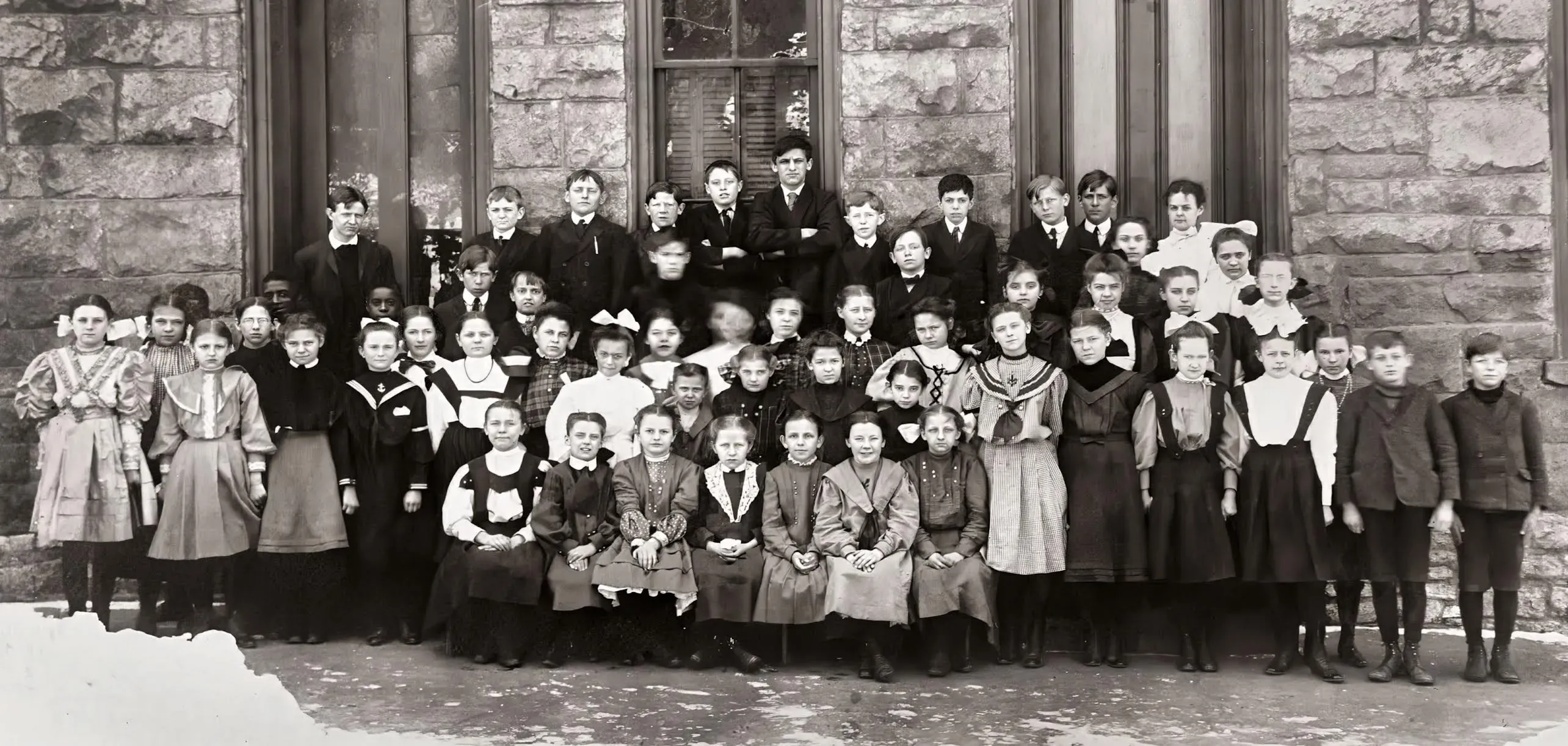
A 1900c photo of Bellefonte school students included the Black students enrolled. (Fred Smith Collection)
It is unlikely that any Black children attended Bellefonte’s earliest public schools. The 1834 law did not expressly require racial integration of common schools or prescribe separate facilities for the education of Black children. As a result, most Pennsylvania municipalities ignored the mandate, leaving Blacks to fend for themselves.
In Bellefonte, the fledgling African Methodist Episcopal Zion (AMEZ) congregation erected a hewn-log building in 1838–39 to serve as both schoolhouse and church. The congregation then established in the building a “Colored School” (as such institutions were then known), supplying teachers from the congregation.
When financial difficulties forced AMEZ to vacate that building in 1847, members of a recently organized African Methodist Episcopal (AME) congregation, aided by white neighbors, built a church-and-schoolhouse on Spring Township’s Halfmoon Hill. Of the fifty school-age Black children counted in Bellefonte and adjoining Spring Township during the 1850 census, roughly half attended the school on Halfmoon Hill.
In 1841, Bellefonte’s school board erected a two-story frame schoolhouse near the crest of East High Street and consolidated the borough’s four common schools under one roof. By 1850, as many as 300 white students attended classes there. This facility served the borough for over a quarter-century, growing ever more congested.
In 1869 the school board built a larger replacement on the southwest corner of North Allegheny and West Lamb Streets. When it opened for classes in September 1869, this brownstone “North Ward” school (a.k.a. “Stone School”) accommodated nearly 500 white students.
Black children had been formally excluded from Bellefonte’s public schools beginning in May 1854 when the Pennsylvania General Assembly passed a law requiring school districts with twenty or more school-age Black children to establish separate schools for their education. Because Bellefonte had more than twenty school-age Black children in 1854, its school board was supposed to have set up a taxpayer-supported Colored School. They apparently chose not to do so, as no such school is recorded operating through the 1850s and ’60s.
The Fourteenth Amendment to the U.S. Constitution, ratified in July 1868, prohibited any state from denying a person within its jurisdiction “the equal protection of the laws.” The amendment gave Black residents a powerful constitutional basis for pressuring borough officials to establish a taxpayer-funded Colored School.
Bellefonte’s school board, perhaps fearing a lawsuit, finally complied with the law and set up a Colored School during the 1872-1873 school term. The February 12, 1873, issue of the Bellefonte Republican noted “496 pupils in actual attendance at our public schools; the colored school numbers 42.” According to a report published in the Republican eight months later, the room rented for the Colored School—described as “poorly adapted, damp, and not fit for occupancy”—was located “in the old penitentiary building” on East Pike Street, a block north of the courthouse.
Whether responding to appeals or acting on its own initiative, Bellefonte’s school board erected a two-story frame building to house the Colored School. The school near the crest of East High Street welcomed two dozen pupils at the start of the 1875–76 school year in September.
In June 1881, after a lawsuit brought by a Black father whose children had been denied admission to public schools in Meadville, the Pennsylvania General Assembly enacted legislation to “Abolish All Distinction of Race or Color” in public schools. But the law lacked enforcement mechanisms, and most school boards across the state ignored it, including Bellefonte.
That troubled the borough’s Black leaders, who argued that conditions in the single-teacher Colored School lagged behind those in “the Stone School” across town. By the summer of 1885, the conditions had deteriorated enough to prompt Rev. J. J. Morris and three lay leaders of Bellefonte’s St. Paul AME congregation—including Charles Garner Sr., a Civil War veteran who served in the 6th US Colored Troops—to approach the school directors after a board meeting. According to the meeting minutes, the delegation “stated that, in their judgment, their children did not enjoy the same advantages in their school as the pupils of the other public schools of the district and asked that the Board take the proper step to remedy the trouble.”
Reports of the encounter ignited a heated public debate that was carried on in Bellefonte’s politically divided newspapers. Peter Meek, the controversial editor of the Democratic Watchman, railed that “the precipitation of twenty or thirty colored children in among the already overcrowded and uncomfortable white attendance [would be] all wrong, even leaving out of consideration the natural antipathy of the black and white children for each other, which will be likely to produce ill-feeling and discord, and perhaps injury and injustice among them.”
In a letter published in the Centre Democrat, the Black leaders wrote that opponents “misunderstood our designs” and said Black parents did not “want to force our children into the public schools with the white children.” However, they argued that one teacher was not sufficient for the forty-three students who attended the Colored School and that Black students should be taught the same subjects as white students. They also argued that qualified Black students “be advanced to the higher branches of public school studies” offered in high school. “[W]e believe that the colored citizens are entitled to all the rights that the white citizens have under the laws of Pennsylvania,” the leaders wrote.
The furor subsided at the beginning of the 1885–86 school year, when the board improved the Colored School’s educational supplies and provisionally hired a new teacher: Luther Calvin Green, a young Bellefonte barber. When Green proved unable to pass the exam for his teaching certificate, the board replaced him with Milton Furey, a white graduate of the Lock Haven Normal School. Furey performed admirably as the Colored School’s sole teacher for the next two years.
During those years, the school board wrestled with overcrowding at the Stone School, a problem only slightly eased by relocating high school classes to rented rooms nearby. The number of school-age children in Bellefonte had grown by nearly 80 percent during the 1860s, and had increased an additional 44 percent by the mid-1880s.
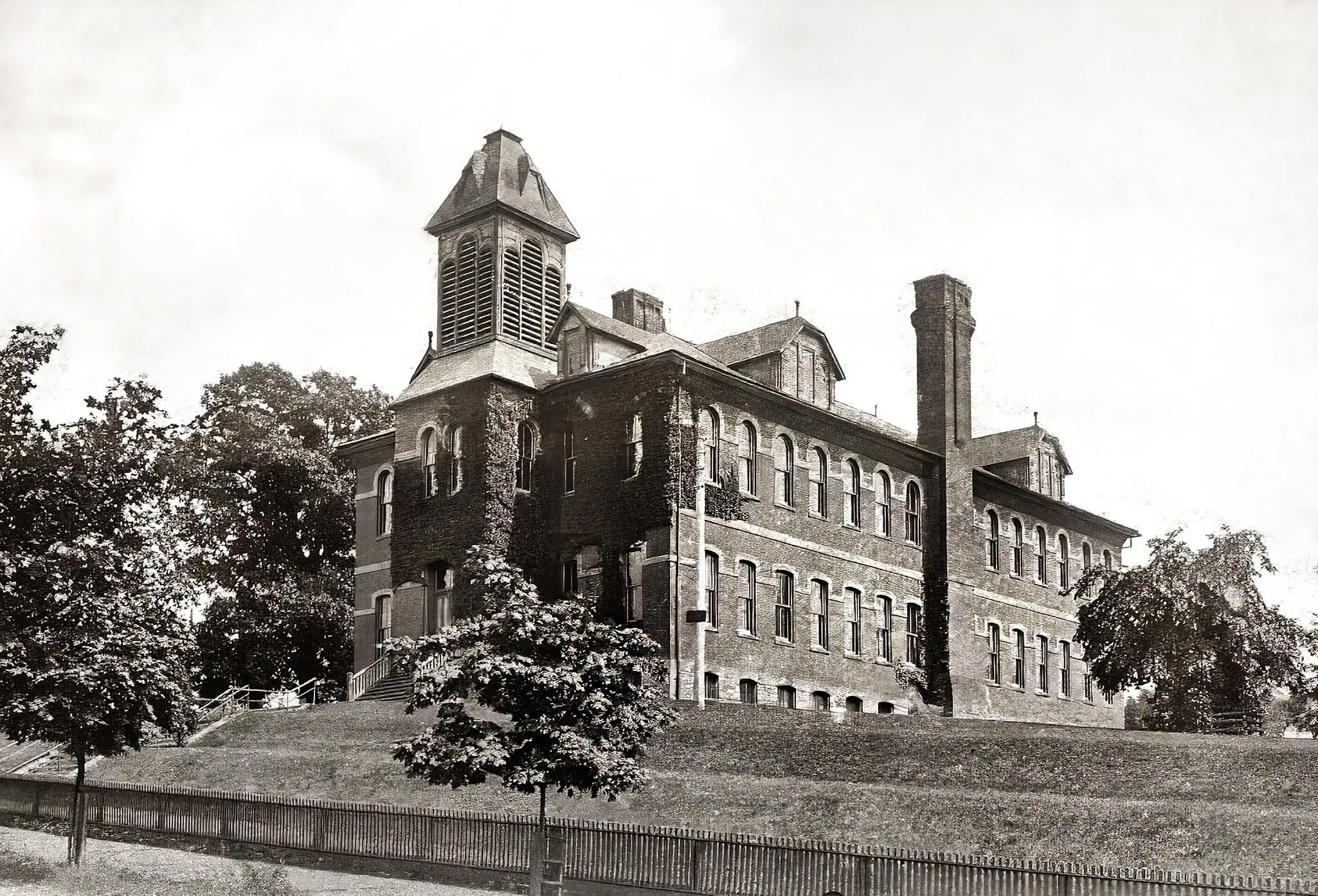
When Bellefonte's new Brick School opened in 1887, the students enrolled included two Black boys and two Black girls. (Fred Smith Collection)
A second schoolhouse was urgently needed, and in the fall of 1885 the board intensified its efforts to construct one. Over the next two years, the board selected a site, drew plans for a two-story brick schoolhouse, and oversaw its construction. Known as the Brick School, the building was hailed at its dedication on September 8, 1887, as “one of the largest school buildings in this part of the State,” equipped with “all first class appliances.”
When classes began two weeks later, the Brick School’s 350 pupils included the borough’s high school students. Among them was ninth grader Charley Garner Jr., whose father had been part of the delegation urging the board to address unequal educational conditions. Charley was one of four Black pupils at the Brick School—two boys and two girls. Across town, the Stone School also opened in mid-September with an even more racially diverse student body. Its 331 pupils included eleven Black boys and sixteen Black girls.
Desegregation occurred quietly and without reported incident. Notably absent from newspaper accounts of the Brick School’s opening and school board meeting minutes was any reference to the watershed desegregation of Bellefonte’s public schools. The school board likely recognized that building a school exclusively for white pupils would be legally indefensible, morally wrong, and—because it would mean funding and operating three separate schools—financially impractical.
Charley Garner remained the face of public-school desegregation in Bellefonte throughout his four years of high school. On May 21, 1891, at the Garman Opera House he joined five white peers and became the first Black student to graduate from Bellefonte High School.
Author
Philip Ruth
Sources
Bellefonte School District Board, meeting minutes, March 24, 1879–September 14, 1897, Centre County Historical Library and Museum, Bellefonte, Pennsylvania.
Centre Democrat (Bellefonte, PA), September 17, 1885, 8.
Democratic Watchman (Bellefonte, PA), September 11, 1885, 8.
Linn, John Blair. History of Centre and Clinton Counties, Pennsylvania. Philadelphia: Louis H. Everts, 1883, 78, 238.
Price, Edward J. Price Jr. “School Segregation in Nineteenth-Century Pennsylvania,” Pennsylvania History 43, no. 2 (April 1976): 121–37.
Ruth, Philip. “Roots of Bellefonte’s African Methodist Episcopal Church,” Black History in Centre County, Pennsylvania (blog), May 12, 2024, https://blkctrco.psu.edu/project-blog/blogarchive/may-12-2024/. (Accessed November 15, 2026).