
C-COR manufactured equipment for the rapidly expanding cable TV industry for three decades after World War II, while its sister firm, Centre Video, owned and operated cable systems throughout Pennsylvania. The two Centre County-based companies were key players in the nation’s development of cable television, and their leaders were generous members of the community.
The origin of the firms sprang from another State College company, HRB, founded in 1947 by George Haller, Richard Raymond, and Walter Brown. The three men had served in engineering and military intelligence during the war. After the war, they all came to Penn State, Haller as dean of School of Chemistry and Physics and Raymond as an associate professor of physics. Brown entered the graduate program earning his Ph.D. in physics in 1949, subsequently joining the faculty.
Leveraging their military experience and connections, the men formed HRB to seek government contracts for engineering research and development. They also dabbled in smaller commercial ventures, one of them television.
Television was growing rapidly across the U.S. Manufacturers were rolling out millions of television sets, and companies large and small were lining up to get licenses to start television stations. Haller, Raymond, and Brown got in that line and created Central Pennsylvania Corp. with plans to open a local TV station.
However, demand for TV station licenses was so high that it broke the federal government’s system for allocating licenses. There were so many technical and policy problems that the Federal Communications Commission decided in 1948 to freeze the granting of new licenses. The freeze lasted until 1952. Blocked in their attempt to start a transmission station, the local group turned their efforts to the reception of existing TV signals.
Nationally, about a hundred stations had been granted licenses to operate before the freeze. One of them was WJAC in Johnstown, which began broadcasting in 1949 and which for several years was the only station in central Pennsylvania. But its signal was hard to receive in the State College area because of the 80-mile distance and the mountainous terrain. That led early TV enthusiasts and entrepreneurs to erect receiving towers, frequently on local mountains or tall buildings, and then retransmit the signal to television owners via amplified wires. It was the beginning of cable television.
Central Pennsylvania Corp. started a small cable system in Bellefonte in 1951. The group built a system in State College about a year later, forming a separate company for it, State College Television Cable Co. At one time the receiving tower for the State College system was on the top of the Penn State water tower near the Nittany Lion Inn.
The cable systems initially offered just WJAC. However, consumers were eager to gain access to more channels, and the entrepreneurs responded to the exploding demand. By the late 1950s, the State College and Bellefonte systems were also carrying WGAL (Lancaster), WFBG (later WTAJ, Altoona), and WNEP and WDAU (Scranton/Wilkes Barre).
Sensing a new opportunity, Haller, Raymond and Brown formed another company, Community Engineering Corp., to distribute the specialty equipment needed to build cable systems. This company established a relationship with an equipment manufacturer, Jerrold Electronics (founded by future Pennsylvania governor Milton J. Shapp). But the firms did not get along, and Community Engineering soon began developing its own products, primarily cable TV amplifiers.
The year that Community Engineering began operations, 1953, was eventful on other fronts for the Penn State group: the cable systems in Bellefonte and State College were combined to create Centre Video Corp.; Raymond left HRB and Penn State to take a position at Rand Corp.; and HRB hired a new engineer, James Palmer, a World War II veteran with a degree in electrical engineering.
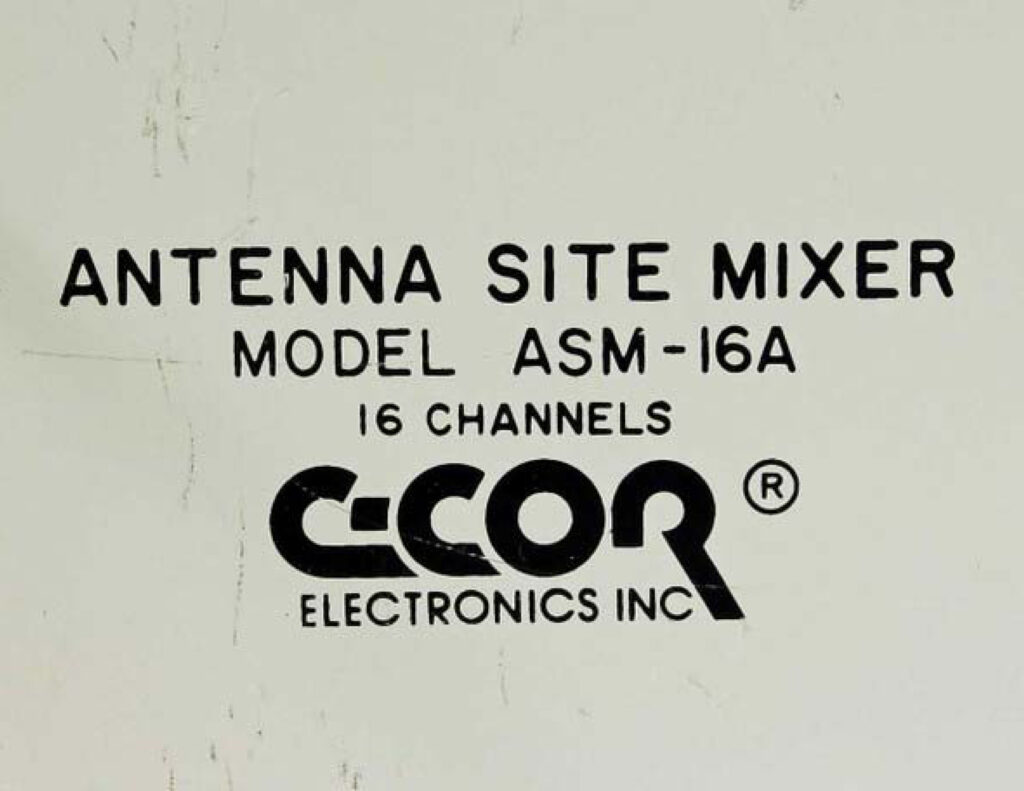
In December 1954, Brown asked Palmer to take the reins of the growing Community Engineering Corp., working as part-time general manager while still doing projects for HRB. Within months, Palmer left HRB altogether to become president of Community Engineering and to raise capital for its continued expansion. At the same time, Community Engineering renamed itself C-COR. More important, it also acquired majority ownership of Centre Video.
In the next two decades, both C-COR and Centre Video prospered. C-COR became one of a handful of companies that dominated the cable television equipment industry. Centre Video expanded its cable system holdings, first in central Pennsylvania with operations in Boalsburg, Port Matilda, and Stormstown, then in the suburbs of Pittsburgh. Overseeing much of Centre Video’s expansion was Robert Tudek, a financial professional who had joined the business in 1965 as vice president and general manager.
By the end of the 1960s, Centre Video had about seventy cable systems but was finding capital for continued expansion harder to come by. Palmer decided to focus on the equipment and engineering side of the industry. He sold Centre Video and agreed to merge the company with TeleCommunications, Inc. (TCI). It was a merger in name only, however, as TCI took full control of Centre Video.
Palmer stayed on as president of C-COR until his retirement in 1985. He and his wife, Barbara, became major benefactors to Penn State, with contributions that included their lead gift to the art museum that was renamed the Palmer Museum of Art. Tudek, along with Everett Mundy, also a Centre Video alumnus, went on to form Tele-Media Corp., another cable system company based in State College. In 1990, Tudek and his wife, Elsie, donated the land for Tudek Park in memory of their son, Tom.
Patrick Parsons
Sources:
James Palmer Oral History. Hauser Oral History Project. The Syndeo Institute at the Cable Center, Denver, Co. https://syndeoinstitute.org/the-hauser-oral-history-project/p-q-listings/james-palmer/
Keller, Edward. “HRB – 50 Years of Excellence: The History of HRB.” HRB Systems, 1997.
Parsons, Patrick. Blue Skies: A History of Cable Television. Philadelphia: Temple University Press, 2008.
Robert Tudek Oral History. Hauser Oral History Project. The Syndeo Institute at the Cable Center, Denver, Co. https://syndeoinstitute.org/the-hauser-oral-history-project/t-v-listings/robert-tudek/
First Published: January 15, 2026
Last Modified: January 29, 2026